

Modern interior designs increasingly incorporate Single Pocket Doors and Bi-fold Pocket Doors to create cleaner aesthetics and improve space efficiency. However, the complexity of on-site assembly and the limited margin for installation errors often lead to longer installation times, higher labor costs, and delays in project completion.
In Reddit's well-known woodworking and cabinetry community, r/cabinetry, one experienced cabinet maker humorously commented:
“As a cabinet maker, I regret them before I even build them. ”
While lighthearted, the comment reflects a common industry concern: traditional pocket door systems can be challenging to manufacture, install, and maintain, especially in projects where efficiency and consistency are critical.
If you are looking for a solution that reduces on-site labor costs and improves project delivery efficiency, this article will explore a key question from an engineering perspective:
Why do traditional pocket door systems often become a bottleneck in the supply chain? And how can a professional pocket door system supplier help manufacturers and contractors achieve faster, more reliable project delivery through modular design and pre-engineered solutions ?

For modern residential and commercial spaces—such as hidden appliance cabinets, large kitchen islands with storage, TV cabinets, and bathroom partitions—pocket door systems have become an effective solution for maximizing space efficiency while maintaining a clean, integrated appearance.
Single Pocket Doors
When opened, the door panel slides completely into one side of the cabinet, eliminating the need for an outward swing radius. This makes the system ideal for narrow cabinets, appliance garages, and localized concealed storage applications where space is limited.
Bi-fold Pocket Doors
Designed for wider and larger cabinetry, bi-fold systems allow two connected door panels on each side to fold together and then slide smoothly into the cabinet pockets. When opened, the system creates a fully unobstructed opening, providing easy access to the entire cabinet interior. When closed, it delivers a continuous and seamless façade that enhances the overall design aesthetic.
As a result, global demand from furniture manufacturers, cabinet makers, and project contractors for heavy-duty pocket door hardware and bi-fold pocket door hardware has shown steady growth in recent years. These systems are increasingly specified in premium residential projects, luxury kitchens, hospitality environments, and custom commercial interiors where both functionality and design are critical.
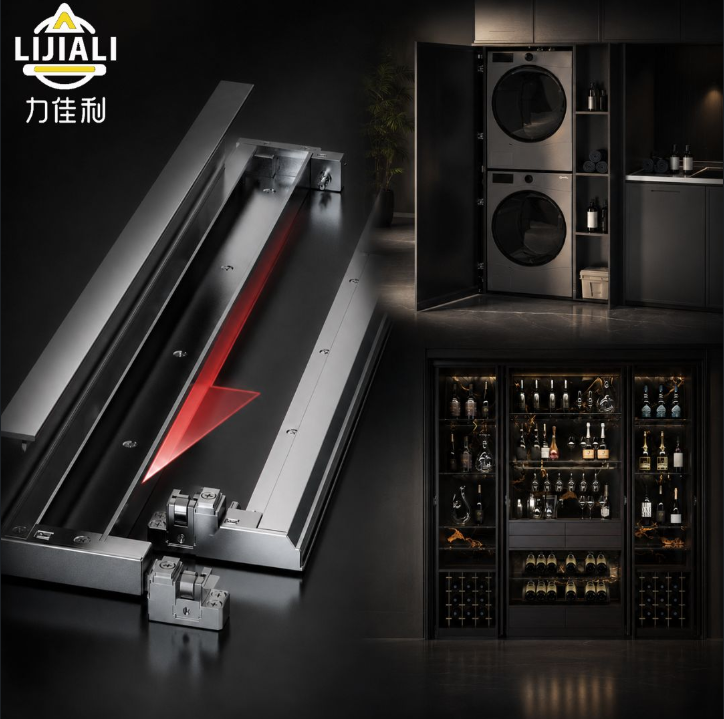
Despite strong market demand, traditional pocket door systems—especially more complex bi-fold configurations—still present several technical challenges for custom furniture manufacturers and project contractors during installation and project delivery.
Traditional pocket door hardware systems typically consist of numerous individual components and require extensive on-site adjustments.
For single pocket door systems, installers must carefully align both horizontal and vertical positions to ensure smooth operation. For bi-fold pocket door systems, the installation process becomes even more demanding due to additional hinges, linkage mechanisms, and multi-track assemblies. Installers must precisely adjust door gaps, panel alignment, and folding-arm movement paths to achieve proper performance.
In many cases, technicians spend significant time making repeated adjustments within narrow cabinet cavities, often with limited visibility and access. In regions where labor costs are high, this directly increases installation expenses and can impact project schedules.
In many traditional cabinet projects, pocket door hardware systems and drawer systems are sourced and managed separately.
As a result, cabinet manufacturers often need to handle a large number of hardware SKUs across different product categories, making procurement planning, inventory management, and warehouse operations more complicated. This complexity can lead to increased administrative costs and reduced supply chain efficiency, particularly for large-scale projects.
As modern interior design increasingly favors floor-to-ceiling cabinetry exceeding 2 meters in height, hardware performance becomes a critical factor in long-term reliability.
If the pocket door hardware lacks sufficient load capacity or structural rigidity, frequent daily use can eventually cause track deflection, door sagging, or misalignment. In bi-fold systems, the joint between the two connected door panels may gradually dip or deform, affecting both appearance and functionality.
These issues often result in service calls, project delays, and costly after-sales rework—challenges that cabinet manufacturers and contractors seek to minimize in order to maintain profitability and customer satisfaction.
To address the practical challenges faced by custom furniture manufacturers and contractors during project execution, we developed the P106 Retractable Pocket Door System along with a complementary heavy-duty bi-fold pocket door hardware system.
Through structural optimization and modular engineering, these solutions are designed to reduce installation complexity, improve project efficiency, and support large-scale deliveries with greater consistency.
One of the key advantages of our pocket door system is the integration of a core component from our drawer system—the P79 Drawer Opener Device.
This cross-platform hardware design allows a single component to serve multiple applications. In addition to helping maintain the stability of retracted door panels—whether in single pocket door or bi-fold pocket door configurations—it also enables cabinet manufacturers to standardize purchasing specifications across product lines.
As a result, manufacturers can reduce SKU complexity, streamline inventory management, and improve overall procurement efficiency.
Traditional pocket door systems often require installers to assemble multiple individual components and perform extensive on-site adjustments.
To simplify the installation process, we pre-assemble critical transmission mechanisms and bi-fold arm assemblies into modular units before shipment.
Compared with conventional piece-by-piece installation, this modular approach significantly reduces the number of installation steps required on-site. Complex multi-dimensional adjustments associated with bi-fold pocket door systems are transformed into standardized fastening and module-mounting procedures, reducing dependence on highly skilled labor.
For large-scale projects with tight delivery schedules, this approach helps contractors maintain installation consistency while improving overall productivity.
The P106 Pocket Door System is specifically designed to meet the demands of tall and heavy cabinet doors commonly found in modern residential and commercial projects.
Constructed from high-strength zinc alloy and ABS engineering plastic, the system is engineered to deliver reliable performance in both high-frequency residential and commercial environments.
The system supports:
· Door height: 1900–2700 mm
· Door width: 440–750 mm
· Door thickness: 18–25 mm
The bi-fold configuration can accommodate even wider cabinet openings, making it suitable for floor-to-ceiling storage cabinets, appliance cabinets, wardrobe systems, and other large-format applications.
With a load capacity of up to 35 kg per side, the system provides stable support for heavy door panels.
This enhanced load-bearing capability helps reduce the risk of door sagging, track deformation, and misalignment over time, particularly in tall cabinetry subjected to frequent daily use.
Smooth and Quiet Operation
The system incorporates a concealed track design and is equipped with LIJIALI hinges, while remaining compatible with soft-close damping mechanisms.
This combination helps minimize closing impact, reduce operational noise, and deliver a smoother user experience. By reducing mechanical stress during operation, the system also contributes to the long-term durability of both the hardware and the cabinetry itself.
As a dedicated manufacturer deeply rooted in the hardware industry, we are committed to providing our B2B clients with stable supply chain support and competitive profit margins:
In-House R&D and Manufacturing: From our single and bi-fold pocket door systems to the P79 drawer components, our entire product range is engineered and manufactured in-house. This grants us direct pricing control at the manufacturing level, effectively safeguarding your project margins.
Engineering and Bulk Delivery Capabilities: We specialize in wholesale pocket door hardware and pocket door hardware bulk fulfillment. Every batch undergoes rigorous cyclic fatigue and durability testing prior to shipment, ensuring zero-defect product delivery for large-scale projects.
Comprehensive Technical Assets: We provide our partners with complete 3D installation drawings and step-by-step video guides, streamlining the learning curve and helping your installation teams ensure seamless on-site implementation.